National figures say foreign demand fell in early 2026. Dutch purchases in the land-registry series kept rising. What that means around Jávea.
Dutch buyers on the Costa Blanca in 2026: still rising while the wider foreign market cools
National headlines this October say foreign buyers purchased fewer homes in Spain in the first half of 2026. That is true in the Housing Ministry’s notary count. It is not the whole story for Dutch buyers, and it is not a figure for Jávea.
Holiday-home demand fell faster than demand from foreigners who already live in Spain. Even so, 2025 was the strongest year on record for Spanish home sales, and the first half of 2026 was still the second strongest. A cooler market after a boom is not the same as a slump.
This note is for people buying or selling around Jávea, Moraira, Benissa, Benitachell and Dénia. Spain publishes two official series. They do not count the same way, and they should not be added together.
Our seller note this autumn used the land-registry picture, where foreign buyers took a record share of second-quarter sales. The paragraphs below put the newer notary volumes next to that picture.
What the notary figures say
Spain’s Housing Ministry counts sales completed before a notary. For the first half of 2026 it reported:
- 353,557 homes sold, down 7.1% on the same period in 2025
- Foreign buyers: 57,595 homes, down 12.6%
- Spanish buyers: down 6.1%
- Foreign non-residents, mostly holiday and second homes: down 17%, to 22,610
- Foreigners living in Spain: down 9.6%, to 34,985
- Foreign share of all sales: 16.3%, from 17.3% a year earlier
- The foreign drop was 14.6% in the first quarter and a smaller 10.7% in the second
Non-resident holiday-home purchases fell by double digits in the main coastal regions. Andalusia was the least weak: down 14% across the half, and only 2% in the second quarter. The Balearics, the Canaries and Catalonia were still down by more than 20% in the second quarter. The Valencian Region and Murcia are described as substantial falls as well. That release does not give a municipal split, so there is no honest Jávea or Alicante percentage to quote from it.
Prices did not follow volumes down. In the same ministry’s price series, the average home sold in the first half went for €225,493, up 9%. New homes averaged €300,910. Resales averaged €217,956. The gap between those two averages narrowed from 58% in 2024 to 38%.
What the land-registry series says about Dutch buyers
The land registrars count purchases on a different timetable. Do not add their totals to the notary totals above. In the registrar series published over the summer of 2026:
- Foreign buyers completed 51,627 purchases in the first half, up 4%, the strongest first half in that series
- In the second quarter, foreign buyers were 15.98% of sales, the highest share the registrars have recorded
- Dutch buyers completed 3,489 purchases in the first half, up 12.3% on the year, and more than four times the first half of 2017
- In the second quarter alone: 1,862 Dutch purchases, up 19.5%, ahead of the 11.3% rise for foreign buyers as a whole in that same series
- Dutch share of foreign purchases in the second quarter: 6.9%, from 6.5% a year earlier and 2.5% in 2017
- If the second quarter of 2017 is 100, Dutch demand now reads 476, against 172 for foreign buyers overall
- Over the four quarters to the end of June 2026: 6,537 Dutch purchases, up 12.1%. The previous twelve months had risen 34.4%. The pace is slower. The base is much higher.
- British buyers were still just ahead for the half, at an estimated 3,567 purchases, down 10%. In the second quarter the counts were 1,843 British and 1,830 Dutch
One national series says foreign volume fell. The registrar series says Dutch volume kept rising, and rose faster than foreign demand as a whole.
What these figures do not say
- They do not give a percentage for Jávea, Xàbia, Moraira, Benissa, Benitachell or Dénia
- A “substantial fall” for non-resident holiday homes in the Valencian Region is not a number, and it is not a number for buyers who already live in Spain
- Many Dutch clients are a mix of a second home and a move. They are not one category in these tables
- A strong Dutch series does not mean every listing on this coast is busy
How this feels on the North Costa Blanca
On the ground the market is still two speeds.
- Turnkey homes in strong spots still draw serious viewings when the price matches recent sales. That includes walkable Jávea, the hills behind Moraira harbour, and kept streets in Benissa Costa, Benitachell and Dénia.
- Tired, poorly documented or overpriced homes sit. Buyers who fly in have already compared the portals. They use time on the market.
Less frenzy is not a collapse. National prices were still up 9% in the first half, so the homes people actually want are not suddenly cheap. Scarce, well-finished stock is still scarce.
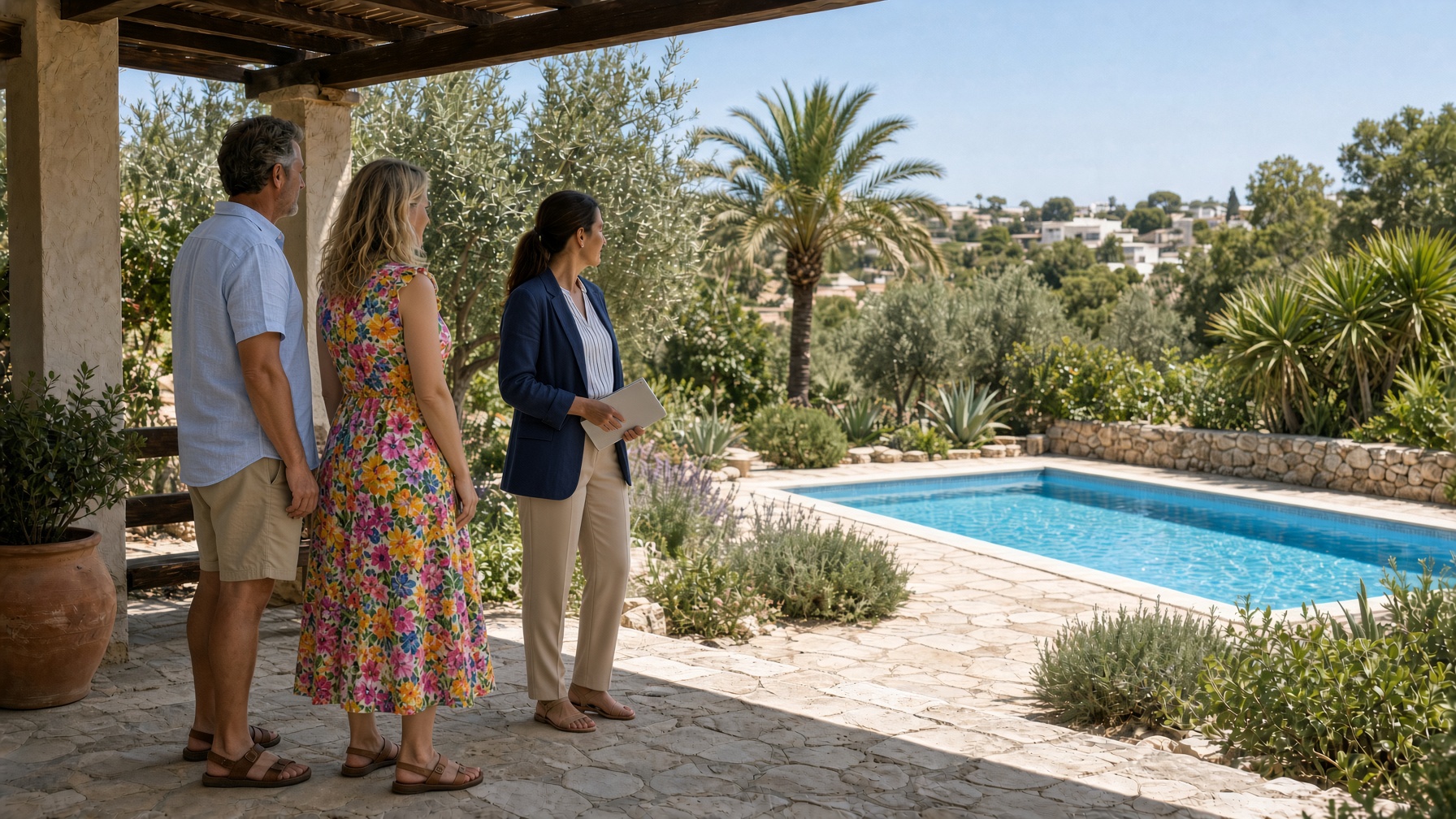
A quiet terrace and a second, careful viewing are a normal rhythm in 2026. They are not a sign that Dutch demand has left the coast.
The practical checks have not changed. We have already written about harder negotiation, how to price a sale this autumn, pools, community fees in an urbanisation, and schools for a family move. Those details decide more viewings than a national headline.
If you are buying from the Netherlands
The useful reading is more time, not a fire sale.
- You can compare more than one home on the same trip. The best ones still go while you are deciding.
- Negotiation is real on homes that have gone quiet. It is thin on homes that match the brief.
- Ask early about community fees, the pool and its licence, the energy certificate, and any extension that is not on the title.
- Instruct your own Spanish lawyer before reservation money moves. A good viewing is not due diligence.
- Build the full cost: price, transfer tax or VAT, notary and land registry, then the first year of community fees and insurance. A national average is not a Jávea budget.
If you are selling
Dutch enquiry is one part of the buyer pool, not the whole of it. British purchases in the registrar series were down on the year. Non-resident holiday homes were the weakest slice in the notary series.
- Price for cautious, well-informed buyers. A realistic ask that earns a second viewing beats a hopeful ask that earns silence.
- A national dip in holiday-home purchases is a reason to be straight about condition and paperwork. It is not a reason to panic-cut a home that is already priced on recent local sales.
- Treat the first month as information. Soft feedback early is cheaper than a stale listing in the spring.
- Presentation still does the work a headline cannot: current photos, an honest energy certificate, and a clear answer on licences.
Bottom line
On the notary count, foreign purchases in Spain fell in the first half of 2026, and holiday-home buyers fell fastest. On the land-registry count, Dutch purchases kept rising and are now almost level with British ones. Both statements can stand, because they are different counts. Neither is a price for your street in Jávea.
If you want a shortlist, or a straight reading of one home around Jávea, Moraira, Benissa, Benitachell or Dénia, talk to Moments Estates. We will tell you what is actually being viewed, and where a national percentage should not be used.
.jpeg)