
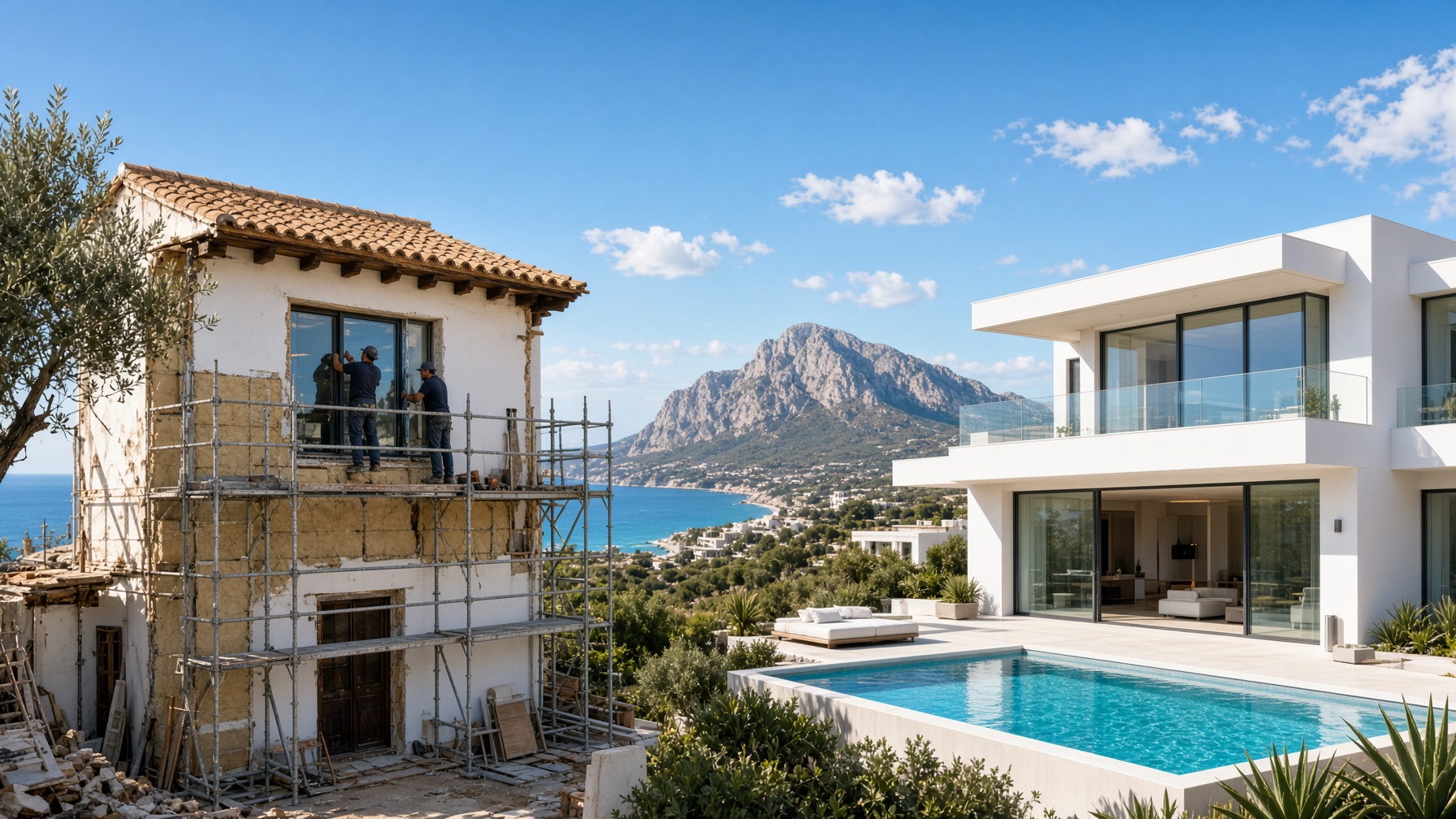
Price, energy bills and resale speed decide the winner. Here’s how new builds compare with renovating older stock on the Costa Blanca for 2026–2027.
Renovate or Buy New on the Costa Blanca? What Looks More Profitable in 2026–2027
On paper, an older villa in Jávea or a dated apartment in Calpe often looks cheaper than a new build in the same municipality. In 2026–2027 that headline gap is only half the story. Purchase price, energy performance and how fast you can sell (or rent) again decide which route actually makes money.
This is not a claim that one path always wins. It is a practical framework Moments Estates clients can use when comparing a turnkey new home with a resale that needs work — especially in the North Costa Blanca market where international buyers are increasingly selective.
The three profit levers that matter now
1. Price (entry cost vs all-in cost)
New build
- Higher asking price per m² in most comparable locations.
- Tax route is usually IVA (10%) + AJD rather than ITP on resales — run the full spreadsheet, do not compare sticky prices alone.
- Staged developer payments can ease cash flow during construction; you may wait months (or longer) before you can live in or rent the home.
- Fewer “surprise” structural costs in the first years if the developer and warranty stack are solid.
Resale + renovate
- Lower headline price is common, especially on 1990s–2000s stock.
- After the Valencian Community ITP adjustment for qualifying resales, acquisition tax on many existing homes is more competitive than buyers remember from older guides — still model your exact band with an advisor.
- Renovation budgets routinely overrun. Windows, roof insulation, electrics, bathrooms, kitchens and pool plant add up fast on hillside villas.
- All-in cost = purchase + tax + notary/registry + survey + works + holding costs while the house is uninhabitable or unrentable.
Profit rule: a “cheap” resale only wins if the completed cost (including a realistic contingency of 15–25% on works) still undercuts a true comparable new build in the same micro-location. Comparing a fixer in a weak urbanisation with a new villa above Moraira is not a fair test.
2. Energy (running cost and regulation)
Energy is no longer a footnote on the Costa Blanca. Buyers in 2026 already use weak EPCs as negotiation leverage; looking into 2027, EU building-performance pressure and buyer awareness keep rising.
New build
- Typically designed to modern standards: often A or B ratings, better glazing, insulation, aerothermal or efficient HVAC, sometimes PV.
- Lower monthly cooling/heating costs in Costa Blanca summers and mild winters.
- Easier story for future buyers and tenants; less fear of “forced upgrade” narratives.
Resale + renovate
- Unrenovated stock frequently sits in D–G territory. That shows up in bills and in offers.
- Targeted upgrades (windows, roof/façade insulation, heat pump, solar where feasible, LED and controls) can move a property meaningfully up the certificate — sometimes from E/F toward C/D or better, depending on the starting point and fabric.
- Not every euro of renovation returns 1:1 in sale price, but failing to fix a disastrous EPC increasingly costs more in time-on-market and discounts than the works themselves.
Profit rule: treat energy works as part of the investment case, not as optional décor. If you will not upgrade a weak certificate, assume a slower sale and a tougher negotiation in 2026–2027.
3. Sellability (liquidity when you exit)
In a market where buyers negotiate harder than in 2021–2022, liquidity is profit.
New build advantages for exit
- Modern layouts, parking, lifts, community pools and “move-in ready” photos match what international portals push.
- Strong energy story and warranties reduce buyer anxiety.
- Risk: large developments can have competing resales from neighbours in the early years; micro-location and build quality still decide whether you exit cleanly.
Renovated resale advantages for exit
- Prime established locations (walk-to-town Jávea, Moraira harbour hinterland, Altea character streets) are hard for new supply to copy.
- A well-documented renovation with invoices, licences and a fresh EPC can outcompete both tired stock and anonymous new urbanisations.
- Risk: partial, amateur or unlicensed works scare buyers and solicitors — that destroys sellability overnight.
Profit rule: the fastest exits in 2026–2027 tend to be either genuinely turnkey new in a proven pocket, or fully finished, legally clean renovations in scarce locations. Half-finished projects and “needs updating” listings linger.
Which route looks more profitable in 2026–2027?
New build tends to win when
- You value time certainty and low operational friction (own use or simple holiday let).
- You compare against resales that need heavy structural or energy work in the same band.
- You will hold through early soft competition in the development and exit on specification + lifestyle, not on being the cheapest m².
- You need a clean A/B energy narrative for financing, tenants or a later sale.
Renovation tends to win when
- You secure a scarce micro-location new builds cannot replicate at the same budget.
- You can control costs (trusted builder, staged scope, contingency) and finish to a level today’s buyers photograph well.
- Energy upgrades are planned from day one, not bolted on after the kitchen is chosen.
- You buy with negotiation room on a tired listing and recycle that discount into works that move EPC and presentation.
The hybrid that often beats both extremes
Buy a structurally sound resale in a strong street or urbanisation, spend selectively on energy + bathrooms/kitchen + outdoor living, obtain a new EPC, and market it as turnkey. That package frequently beats both an untouched bargain and an overpriced off-plan unit in a weaker setting.
A simple decision spreadsheet (use real quotes)
For any shortlist, fill in both columns:
- Purchase price
- Transfer taxes and buying costs
- Essential works (with contingency) or waiting cost until new-build handover
- Expected annual energy cost (order-of-magnitude from EPC / comparable bills)
- Realistic gross rent (if investing) or your own use value
- Likely sale timeline and discount risk if listed in 24–36 months
Then ask: which column still wins if works overrun 20% and the sale takes three months longer? That stress test is more honest than brochure yields.
Costa Blanca specifics to keep in mind
- North vs product type: hillside villas from the 1990s–2000s often hide the biggest energy and waterproofing bills; apartments in managed communities can be cheaper to upgrade but limited by community rules.
- Licences matter: unlicensed extensions or pool works destroy sellability regardless of how pretty the kitchen is.
- Buyer pool: Dutch, Belgian, German, French, British and Scandinavian buyers still dominate many North Coast searches — they compare energy and finish ruthlessly online before they fly.
- 2027 outlook: expect energy and “ready to live” to stay decisive even if headline price growth cools. Liquidity will favour homes that do not need a second renovation story.
Bottom line for Moments Estates clients
More profitable in 2026–2027 is rarely “new” or “old” as a slogan. It is the option with the best all-in cost, a credible energy story, and a clear exit buyer in your micro-location.
If you are torn between an off-plan unit and a renovation candidate in Jávea, Moraira, Altea, Calpe or Dénia, we can compare them side by side: acquisition maths, likely works, EPC implications and how similar homes are actually selling today — not how they looked in 2022.
Speak with our team for a property-specific renovate-vs-new build assessment before you reserve or make an offer.
.jpeg)